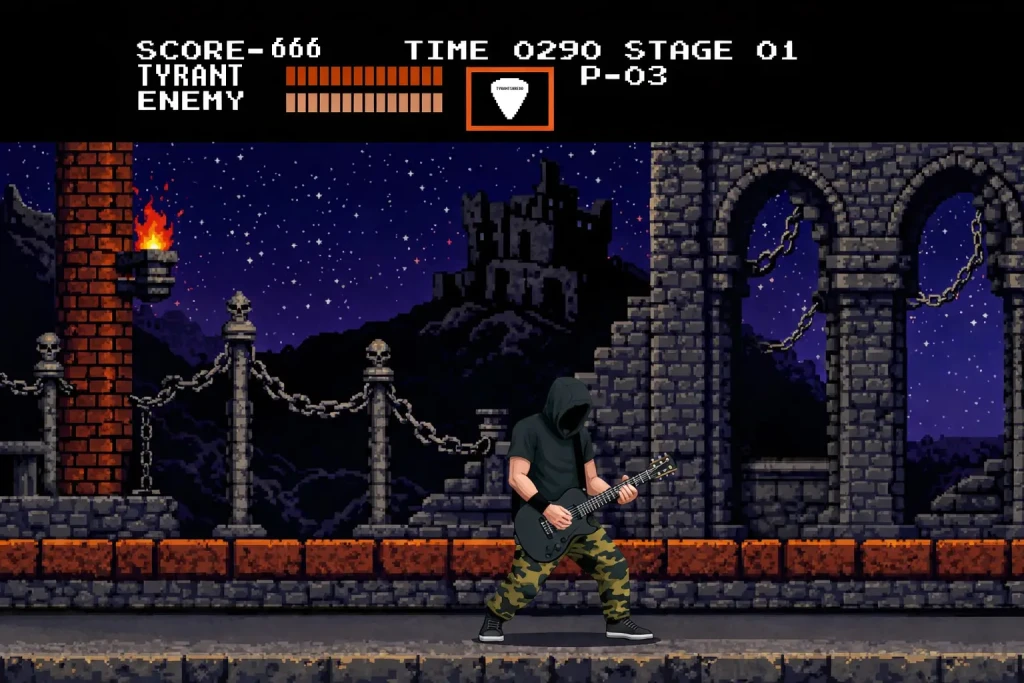
Castlevania has given me a lot over the years. Riffs, moods, tension, and that unmistakable dark elegance that somehow came out of an 8-bit console. Out of all its tracks, Poison Mind has always hit me differently. This boss battle theme from the original NES game was intense, sinister, and oddly sophisticated for its time. Even now, decades later, it still feels sharp. Still dangerous. Still alive.
That is exactly why I decided to build a new arrangement around it. Not just a cover. Not a nostalgia run. I wanted to force technique to serve the music, not the other way around. The result is an arrangement that pushes hybrid picking to the front and refuses to let you cheat your way through it.
This version of Poison Mind demands discipline.
Why Poison Mind still matters
Poison Mind is not flashy in the traditional sense. It does not rely on melody alone. It relies on rhythm, articulation, and tension. On the NES, those elements had to do all the heavy lifting. Every note had to count. That philosophy is exactly what I wanted to preserve.
When you strip away modern production tricks, you realize how brutal this track really is. The staccato phrasing. The rapid alternation between registers. The constant pressure. This is not background music. This is a warning.
So I treated it that way on guitar.
The hybrid picking rule (no exceptions)
Here is the core rule of this arrangement:
Every single time you hit the G-string, you must use your middle finger.
No exceptions.
All bass notes are picked. All G-string notes are plucked with the middle finger. That separation is what creates the articulation this arrangement lives and dies on.
At fast tempo, this becomes extremely challenging. Your right hand wants to default to efficiency. Your brain wants to simplify. This arrangement refuses to let you.
The moment you break the rule, the feel collapses.
Why not just use a pick?
Yes, it can be played entirely with a pick. Technically. Physically. Mechanically.
But here is the honest truth.
You lose the staccato authority.
Hybrid picking allows you to kill the note instantly. The middle finger snaps the string and releases it cleanly, while the pick handles the low-end attack. Each note exists on its own.
That clean separation is the sound of Poison Mind.
With pure alternate picking, the notes connect whether you want them to or not. Even with tight muting, there is a softness that creeps in. It sounds fast, but not dangerous. Precise, but not surgical.
Hybrid picking gives you control over when the note stops, not just when it starts.
That matters.
Staccato as attitude, not just technique
This is not about showing off hybrid picking. It is about enforcing restraint.
Staccato playing is unforgiving. You cannot hide behind sustain, you cannot rely on gain, you cannot rush sloppy transitions. Every note is exposed. Every mistake is audible.
That is why this arrangement feels aggressive even without excessive distortion. The aggression comes from clarity. From intention. From the refusal to let notes bleed into each other.
That mindset fits Castlevania perfectly.
What this arrangement teaches you
If you work through this piece properly, it will expose weaknesses fast.
- Right-hand independence
- Timing under pressure
- Consistent articulation at speed
- Control over note duration
- Mental focus while switching techniques
You are not just learning a song. You are training decision-making at tempo. That is far more valuable than memorizing patterns.
Final thoughts
Poison Mind has survived because it was built on fundamentals. Rhythm. Space. Threat. This arrangement respects that by refusing shortcuts. Hybrid picking is not used because it is trendy. It is used because it is the correct tool for the job.
If you are comfortable with this piece, your picking discipline is solid. If it feels uncomfortable, that is the point. Castlevania never played fair.
Neither should your practice.
This is TyrantShredd. Precision over comfort. Clarity over speed. Darkness with intent.