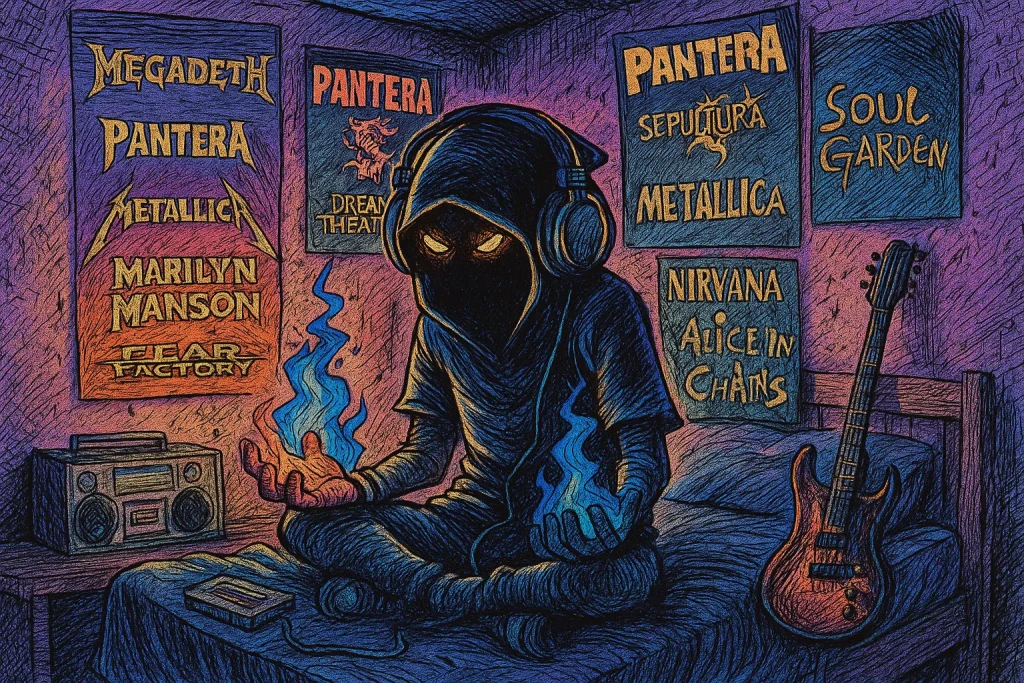
Alright today it is all about guitar influence. This one’s personal, technical, and unapologetically opinionated. No mythology, no polite revisionism. Just the real chain of influences that shaped how I actually play guitar under the Tyrantshredd banner.
This is not a “greatest guitarists of all time” list.
This is my list.
The list is not in order of discover, instead, it is a list of the 10 most influential artists/bands, with #1 being the most influential.
10. Joe Satriani
Legato as a weapon, not a gimmick
Satriani was my gateway drug into legato. Before him, speed felt stiff. Boxy. Mechanical. Joe showed me that notes could flow instead of being attacked one by one.
His phrasing taught me that shred doesn’t need to sound aggressive to be effective. Hammer-ons and pull-offs became tools for momentum, not shortcuts. That idea stuck with me permanently.
I didn’t copy his tone. I didn’t chase his melodic optimism either. But his control over legato phrasing changed how I approached speed forever. Without Satriani, my shred vocabulary would be far more rigid and percussive.
This was the first time I realized that technique could serve feel, not replace it.
9. Marilyn Manson / Daisy Berkowitz
Riffs, image, and controlled chaos
Daisy Berkowitz doesn’t get enough credit. Period.
Some of the most memorable, twisted, and effective metal riffs of the 90s came from a mindset that wasn’t obsessed with precision or theory. It was about vibe, ugliness, and intention.
Marilyn Manson as a band also showed me something most guitarists ignore: theatrics matter. Presentation matters. Atmosphere matters. Music is not just sound. It’s experience.
That campy, off-kilter approach to riff writing taught me that perfect technique means nothing without identity. That lesson shows up constantly in how I write and structure riffs today.
8. Sepultura / Max Cavalera
The power of riffs as a unit
This influence is very specific: the classic Sepultura era.
Max Cavalera’s riffs during that period were raw, tribal, and brutally effective. No excess. No overthinking. Just pure impact.
I was never a fan of Andreas Kisser’s leads. That’s not revisionism, that’s honesty. But the band as a unit was unstoppable.
Their concert Under Siege is one of my favorite metal performances ever. And yes, it was heavily produced and edited in studio conditions. That does not weaken it. If anything, it reinforces an important truth:
Metal is allowed to be constructed.
Raw does not automatically mean better.
That mindset heavily influenced how I think about production and tightness.
7. Yngwie Malmsteen
Technique unlocked
Yngwie wasn’t about emotion for me. He was about possibility.
Arpeggios. Economy picking. Structured speed. Suddenly the fretboard wasn’t a mystery anymore. It was a system.
Learning Yngwie’s mechanics opened doors I didn’t even know existed. Economy picking, in particular, became a permanent part of my arsenal. Once you understand it, you can’t unsee it.
You don’t have to like his music to respect what he introduced technically. If you play shred and ignore Yngwie’s influence, you’re lying to yourself.
6. Rusty Cooley
The skill ceiling
Rusty Cooley is where ego goes to die.
Learning pieces like Under the Influence forced me to confront my limits. This wasn’t just speed. This was discipline. Crazy sweeps. Relentless alternate picking. Ostinatos that demand stamina and precision.
Rusty didn’t inspire me emotionally. He challenged me physically. He raised the bar and made sure I knew exactly where it was.
Every serious shredder needs an artist like this. Someone who doesn’t care how “musical” you feel and just asks: Can you actually play?
5. Jason Becker
Technique with soul
Jason Becker is the rare case where unbelievable technique and deep musicality coexist naturally.
Learning Altitudes, Air, and Mabel’s Fatal Fable reshaped how I think about melody. These weren’t just exercises. They were compositions.
Becker showed me that shred doesn’t need to sound cold or clinical. It can be expressive, dramatic, even vulnerable.
He is the reason I never fully separated “technical” and “musical” playing in my head.
4. Meshuggah / Fredrik Thordendal
Rewiring rhythm
Meshuggah hit me late. About a decade into playing.
Once they did, there was no going back.
Their mechanical precision, rhythmic displacement, and sheer heaviness redefined what metal guitar could be. Bleed is not optional. If you can’t play it properly, you’re not done learning.
This influence reshaped my right hand, my timing, and my tolerance for sloppiness. Meshuggah teaches you that tightness is a discipline, not a vibe.
3. Extreme / Nuno Bettencourt
Funk, groove, and palm-muted fire
Nuno is a monster.
His funky metal riffs, percussive feel, and palm-muted soloing deeply influenced how I approach rhythm guitar. Groove matters. Attack matters. Dynamics matter.
He made metal feel physical without losing sophistication. That balance is something I constantly chase.
2. Metallica / James Hetfield / Kirk Hammett
The foundation
Hetfield wrote some of the greatest metal riffs ever. Period.
Hammett, while not a technical benchmark, provided a gateway into lead guitar. His solos in the 80s and early 90s gave me something to build on before diving into more demanding territory.
Metallica taught me structure. Songwriting. Riff economy. You don’t skip this step and become a well-rounded metal guitarist.
Honorable Mention
Fear Factory / Dino Cazares
Palm-muted machine-gun riffs. Brutal. Precise. Influential even if not top ten.
1. Megadeth / Marty Friedman / Dave Mustaine
The core
Marty Friedman is the single most influential guitarist in my playing.
His vibrato. His phrasing. Also, his refusal to play what you expect. His bends that feel wrong until they feel inevitable.
He taught me that individuality matters more than correctness.
Mustaine’s riff writing defined my understanding of thrash metal. Aggressive, angular, relentless.
Together, they shaped how I think about melody, aggression, and unpredictability.
Final Thoughts on main guitar influence artists
This list explains Tyrantshredd better than any bio ever could.
It’s not about copying.
It’s about absorbing lessons, rejecting what doesn’t resonate, and forging something personal from the chaos.
That’s real influence.